
LEGAL ETHICS IN THE DIGITAL AGE: CHALLENGES FOR LAWYERS IN MAINTAINING CONFIDENTIALITY ONLINE
Confidentiality remains the foundation of the attorney-client relationship. Clients share sensitive personal, financial, and strategic information expecting it to stay protected. This duty is an ethical obligation rooted in professional conduct rules and legal privilege doctrines across common-law jurisdictions. In the United States, ABA Model Rule 1.6 requires lawyers to make reasonable efforts to prevent inadvertent or unauthorized disclosure of, or access to, information relating to a client’s representation. Parallel obligations exist in England and Wales, Canada, Australia, and elsewhere. These rules originated in an era of paper files, locked cabinets, and in-person meetings. They did not anticipate phishing, metadata leakage, cloud breaches, or the lasting digital record of a single careless post.
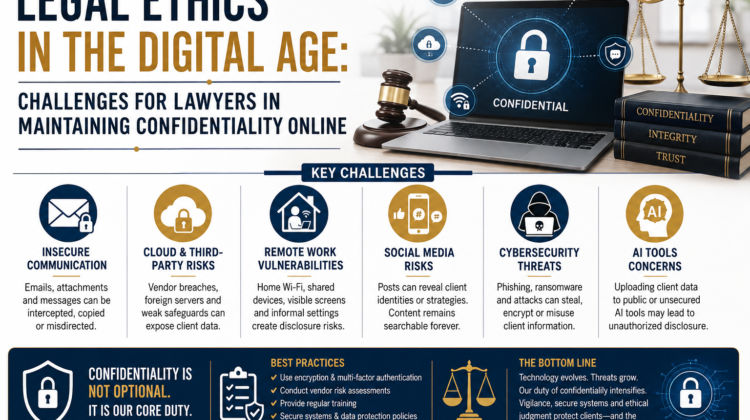
The digital environment multiplies points of vulnerability. Email, still the dominant channel for lawyer-client communication, is insecure without proper encryption. Messages can be intercepted, stored on intermediate servers, or accessed through compromised accounts. Lawyers often forward unprotected attachments or fail to confirm recipient identity. Metadata in documents—author names, revision histories, hidden comments—can reveal privileged material long after sharing. Instant messaging and text applications frequently lack default end-to-end encryption, and deleted messages may survive on servers or backups.
Cloud storage and practice-management platforms introduce additional risks. Firms rely on third-party services for files, calendars, and collaboration. While reputable providers offer strong security, the lawyer remains ethically responsible for assessing those safeguards. A vendor breach can expose thousands of client records simultaneously. Data stored on foreign servers may fall under different privacy regimes or government access laws. Assuming the cloud is inherently secure, without due diligence, breaches both the duty of confidentiality and the duty of competence.
Remote work, normalized after the COVID-19 pandemic, compounds these dangers. Home Wi-Fi networks, shared family devices, visible screens, and informal video-conference settings create opportunities for unauthorized access or accidental disclosure. Social media poses a quieter but persistent threat. Even a brief post referencing a matter by name or describing preparation for a hearing can identify clients or strategies. Platforms harvest data, and content remains searchable indefinitely. Opposing parties and sophisticated adversaries monitor lawyers’ online activity.
Cybersecurity threats have grown more targeted. Phishing, ransomware, and business-email compromise schemes focus on law firms because of the high value of the information they hold. A successful attack can encrypt files, exfiltrate data, or enable impersonation of counsel. Technological competence is now an explicit ethical requirement: lawyers must understand the risks of the tools they use and take reasonable steps to mitigate them. Ignorance is no longer a defence.
Artificial intelligence tools add a further layer. Generative systems can aid research, drafting, and review, yet uploading client information to public or inadequately secured platforms may constitute unauthorized disclosure. Even anonymized data can sometimes be re-identified. Lawyers must examine terms of service, retention policies, and security practices before use.
These risks are not abstract. Regulators have disciplined lawyers for sending confidential documents to the wrong address or storing data on unsecured servers. Civil liability for breaches is rising, and clients increasingly demand proof of robust cybersecurity. Public trust depends on the profession’s ability to keep secrets when secrets are harder than ever to keep.
Meeting the challenge requires technological safeguards, institutional policies, and cultural change. Encryption, multi-factor authentication, regular training, vendor risk assessments, contractual data-protection assurances, and clear engagement-letter language on electronic communication are essential. Continuing legal education must treat cybersecurity and digital ethics as core subjects. Professional organizations have issued guidance on cloud computing, metadata, and social media, and some jurisdictions have updated rules to emphasize technological competence. Yet technology evolves faster than formal rules, leaving primary responsibility with individual lawyers and firms.
The digital age does not weaken the duty of confidentiality; it intensifies it. Clients still expect, and deserve, that their confidences will be guarded with utmost care. Lawyers who treat technology as neutral rather than risky, or who rely on outdated security assumptions, fail both their clients and the profession. Continuous vigilance, investment in secure systems, and willingness to adapt remain the measure of professional integrity in a connected world.