
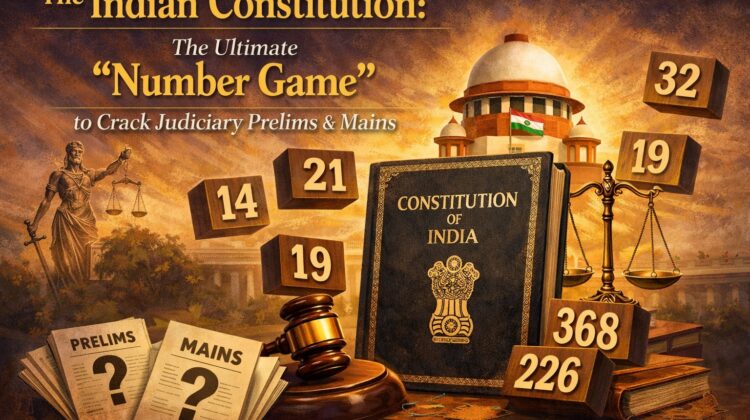
The Indian Constitution: The Ultimate “Number Game” to Crack Judiciary Prelims & Mains
The Indian Constitution is the “Grundnorm”—the foundational source of authority—for the entire Indian legal landscape.
For a judicial aspirant, it is far more than a mere subject on a syllabus; it is the essential lens through which every other statute, whether criminal, civil, or commercial, must be interpreted. Whether you label it as the “Core Pillar,” the “Game Changer,” or the “Ultimate Number Game,” the fundamental question remains: Why is the Constitution the definitive key to cracking the Judicial Services Examination?
The Strategic “Number Game” (Prelims Analysis)
To understand why the Constitution is a “Number Game,” one must look at the cold, hard data from the past years of competitive testing. In the Preliminary rounds across India, the Constitution is not just an integral part of the syllabus—it is often the highest-leverage segment of the paper.
A rigorous analysis of previous years’ papers reveals a staggering trend:
National Average: On average, 17% to 20% of the total questions in the Law paper are derived directly from the Indian Constitution.
High-Weightage States: In states like Uttar Pradesh and Bihar, the stakes are even higher. Aspirants often encounter upwards of 25 to 30 questions dedicated solely to Constitutional Law, making it the primary pillar of their preparation strategy.
When one-fifth of your total score depends on a single subject, mastering it isn’t just an option—it is a mathematical necessity for survival in the merit list.
The “Game Changer” in Mains (Subjective Depth)
While the Preliminary stage tests your memory of Articles and Amendments, the Main examination tests your “Judicial Mind.” In several states, Constitutional Law is a standalone paper or a massive portion of the substantive law exam.
The Lens of All Legislation
Why does the examiner give this subject so much weight? Because as a Judge, the Constitution will be your daily manual. Whether you are protecting a citizen’s Fundamental Rights through Writs or ensuring the “Separation of Powers” is maintained in a local dispute, the Constitution is the constant backdrop.
High-Frequency Constitutional Doctrines & High-Yield Provisions for Judiciary
While a holistic understanding of the entire Constitution is indispensable for strategic preparation for the Judicial Services Examination demands absolute mastery over specific high-yield segments. These “priority zones” are characterized by their recurring presence in both Preliminary and Main examinations.
1. Fundamental Rights: The Core of Constitutional Jurisprudence (Part III: Articles 12–35)
This segment remains the most critical pillar for both objective and subjective papers. It represents the “heart” of the exam.
Article 12 (Definition of ‘State’): Frequent examination of the evolving criteria for “other authorities,” specifically whether statutory bodies, universities, or public corporations fall under the ambit of the State.
Article 13 (Laws Inconsistent with FRs): Mastery of foundational doctrines including the Doctrine of Eclipse, Severability, and the origin of Judicial Review.
The “Golden Triangle” (Articles 14, 19, and 21):
Article 14: The transition from “Reasonable Classification” to the “New Doctrine of Arbitrariness.”
Article 19: Comprehensive knowledge of the six fundamental freedoms and the specific “Reasonable Restrictions” that govern them.
Article 21: The expansive judicial interpretation of “Life and Personal Liberty,” covering the Right to Privacy, Education, and Fair Trial.
Article 32 (Constitutional Remedies): In-depth knowledge of Writ Jurisdiction—Habeas Corpus, Mandamus, Certiorari, Prohibition, and Quo-Warranto—and the “Right to Move the Supreme Court.
2. The Judiciary: The Institutional Framework (Articles 124–147 & 214–237)
As an aspirant for a judicial office, a granular understanding of the court’s structure and powers is non-negotiable.
Appointments, Qualifications, & Transfers: The procedural intricacies of the Collegium system and the constitutional requirements for Supreme Court and High Court Judges.
Article 141: The doctrine of Stare Decisis—the binding nature of Supreme Court precedents on all subordinate courts.
Article 142: The inherent power of the Apex Court to pass orders to ensure “Complete Justice.”
Subordinate Judiciary (Articles 233–235): State-specific exams place heavy emphasis on the appointment and control of District Judges.
3. Directive Principles & Fundamental Duties (Part IV & IV-A)
These sections bridge the gap between individual rights and social welfare, frequently appearing in policy-based questions.
Article 39A: The constitutional mandate for Equal Justice and Free Legal Aid—a topic of high relevance for judicial ethics and procedures.
Article 44: The Uniform Civil Code (UCC)—a recurring theme for contemporary legal essays and descriptive Mains answers.
Article 50: The mandate for the Separation of the Judiciary from the Executive.
Article 51A: Detailed knowledge of the 11 Fundamental Duties, with particular attention to those added via the 86th Constitutional Amendment.
4. Emergency Provisions: The Federal Strain (Part XVIII: Articles 352–360)
These provisions test your understanding of the shifts in India’s federal structure during times of crisis.
National Emergency (Art. 352): Procedural grounds for declaration and its impact on the suspension of Fundamental Rights (noting the non-suspension of Articles 20 and 21).
President’s Rule (Art. 356): Constitutional checks on the dismissal of state governments, specifically the guidelines established in the S.R. Bommai case.
5. Constitutional Amendments & the Basic Structure (Article 368)
This area tests the intersection of parliamentary power and judicial oversight.
Amendatory Procedure: Understanding the different thresholds (Simple Majority, Special Majority, and State Ratification) required for various amendments.
Evolution of Basic Structure: Chronological mastery of the judicial tug-of-war—from Shankari Prasad and Golaknath to the definitive Kesavananda Bharati judgment and the subsequent impact of the 42nd and 44th Amendments.
To Master the Indian Constitution for Judiciary Exams: The Layered “Number Game” Strategy
To master the Indian Constitution for Judiciary exams, you must move beyond rote memorization and adopt a layered preparation strategy
1. Phase-Wise Study Plan (12-Week Blueprint)
Phase 1: Bare Act Foundation (Weeks 1–3) Read the Constitution from cover to cover. Do not memorise yet. Focus on understanding the overall map — Parts, Chapters, and Schedules. Build a strong structural foundation.
Phase 2: High-Yield Deep Dive (Weeks 4–8) Zoom in on the core pillars: Fundamental Rights (Arts 12–35), Judiciary (Arts 32, 226, 124–147, 214–231), and Emergency Provisions (Arts 352–360), and Amendment (Art 368). These areas deliver 80% of your marks.
Phase 3: Interlinking & Case Laws (Weeks 9–12) Connect constitutional provisions with other subjects. Example: Link Arts 20–21 with BNSS (procedural law). Integrate landmark judgments and recent Constitution Bench decisions.
2. Daily & Weekly Time Management
Frequency Task Time Investment
Daily 90-Minute Rule: 60 mins active reading + 30 mins solving at least 30 MCQs 1.5 hours
Weekly Sunday Synthesis: No new topics. Review all handwritten notes + write one 500-word essay on a current constitutional issue 3–4 hours
Monthly Full-Length Mock: Simulate a real Constitutional Law paper under exam conditions 3 hours
Conclusion
Mastering the Indian Constitution is not just another subject to tick off — it is the ultimate Number Game that decides your success in Judiciary Prelims and Mains. With 17–20% weightage, high-yield Articles delivering 80% of the marks, and its role as the daily manual of every judge, consistent application-focused preparation turns this “Grundnorm” into your strongest scoring weapon.
Follow the 12-week layered strategy, stay disciplined with the 90-minute daily rule and Sunday Synthesis, and treat landmark cases as your allies. Do this, and the Constitution will not only help you crack the exam — it will shape you into the judge the nation needs.
Start today. The Number Game is yours to win.




Comments are closed.