
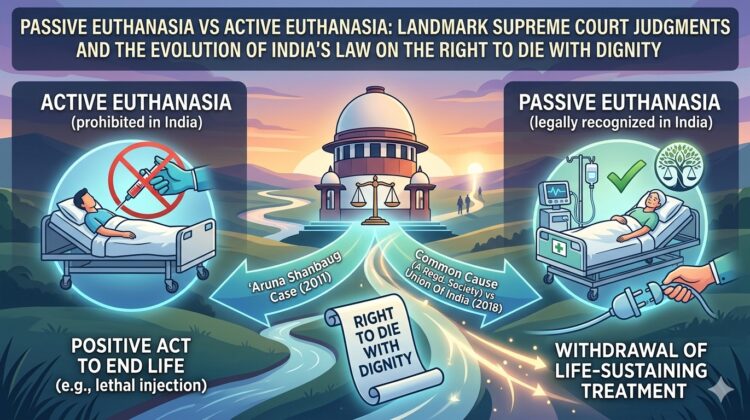
PASSIVE EUTHANASIA VS ACTIVE EUTHANASIA: LANDMARK SUPREME COURT JUDGMENTS AND THE EVOLUTION OF INDIA’S LAW ON THE RIGHT TO DIE WITH DIGNITY
Euthanasia — the act of ending life to relieve unbearable suffering — remains one of the most ethically, medically, and legally charged debates in India. At its core lies a fundamental question: Does the “right to life” under Article 21 of the Constitution include the “right to die with dignity”?
The Supreme Court of India has answered this through a series of landmark judgments, clearly distinguishing between “active euthanasia” and “passive euthanasia”. While “active euthanasia” remains illegal, “passive euthanasia” has been progressively recognized and regulated as a facet of the right to life with dignity.
This blog explains the key differences and traces the complete legal evolution through every major Supreme Court judgment in chronological order.
- UNDERSTANDING THE DIFFERENCE: ACTIVE VS PASSIVE EUTHANASIA
| Aspect | Active Euthanasia | Passive Euthanasia |
| Definition | Positive, deliberate act to cause death (e.g., lethal injection, poison)
|
Withholding or withdrawing life-sustaining treatment (e.g., ventilator, feeding tube, artificial nutrition)
|
| How death occurs
|
Death caused by an external act/introduction of a new harmful agent
|
Death caused by the underlying disease/illness itself (treatment merely allows natural death)
|
| Legal Status in India
|
Prohibited (amounts to murder under IPC unless Parliament legislates)
|
Legal under strict Supreme Court guidelines for terminally ill or patients in Persistent Vegetative State (PVS)
|
| Ethical View
|
Viewed as “killing” by commission
|
Viewed as “letting die” by omission
|
| Patient’s Role
|
Requires direct intervention by doctor
|
Doctor stops artificial prolongation of life
|
“Key Principle Laid Down by the Supreme Court”: In passive euthanasia, the cause of death is the disease, not the doctor’s act. In active euthanasia, the doctor’s act becomes the direct cause of death.
- LEGAL EVOLUTION: LANDMARK JUDGMENTS IN CHRONOLOGICAL ORDER
Case :- (i) Gian Kaur v. State of Punjab (1996) – The Foundation
A five-judge Constitution Bench overruled the earlier *P. Rathinam* (1994) judgment and held that:
– The “right to life” under Article 21 does “not” include the “right to die”.
– Sections 306 (abetment of suicide) and 309 (attempt to suicide) of the IPC are constitutionally valid.
– The Court distinguished “euthanasia” from ordinary suicide but left the door slightly open for “death with dignity” in cases where natural death has already begun.
“Impact”: This judgment closed the door on any “right to die” but planted the seed for future recognition of dignity in dying.
Case:- (ii) Aruna Ramchandra Shanbaug v. Union of India (2011) – First Recognition of Passive Euthanasia
The most famous euthanasia case in India. Aruna Shanbaug, a nurse in a Persistent Vegetative State (PVS) for 37 years after a brutal assault, was the subject of a mercy plea by journalist Pinki Virani.
“Key Holdings”:
– “Active euthanasia” was rejected outright and remains illegal without legislation.
– “Passive euthanasia” was “legalised” for the first time in India under strict safeguards.
– The Court laid down detailed guidelines: High Court approval required, opinion of medical board mandatory, “next friend” or family consent considered.
– Distinguished active (positive act) from passive (withdrawal of support).
“Landmark Contribution”: For the first time, the Supreme Court explicitly permitted passive euthanasia while adopting the *parens patriae* (parent of the nation) role to protect vulnerable patients.
Aruna’s plea was ultimately rejected (hospital staff opposed it), but the judgment became the foundation for future law.
Case :- (iii) Justice K.S. Puttaswamy v. Union of India (2017) – Right to Privacy Strengthens Dignity
The nine-judge bench unanimously declared the “right to privacy” a fundamental right under Article 21.
“Relevance to Euthanasia”:
– Privacy includes “bodily autonomy”, “self-determination”, and “personal dignity”.
– This judgment became the constitutional bedrock for later euthanasia cases, reinforcing that forcing a person to live in a vegetative or terminally ill state against their dignity violates Article 21.
Case :- (iv) Common Cause v. Union of India (2018) – Right to Die with Dignity Recognised
A five-judge Constitution Bench delivered the most authoritative judgment on the issue.
“Key Holdings”:
– “Right to die with dignity” is an integral part of the “right to life” under Article 21.
– “Passive euthanasia” and “living wills” (Advance Medical Directives) are legal.
– Detailed guidelines issued for two scenarios:
- When the patient has executed a living will.
- When no living will exists (surrogate decision by family/doctors).
– Reiterated that “active euthanasia” cannot be permitted without parliamentary legislation.
– Emphasized individual autonomy, informed consent, and protection against misuse.
This judgment expanded *Aruna Shanbaug* and gave constitutional sanctity to passive euthanasia.
Case :- (v) Common Cause v. Union of India (2023) – Simplified Guidelines
A five-judge bench modified the 2018 guidelines to make them practical:
– Removed cumbersome requirements (e.g., mandatory judicial magistrate countersignature).
– Streamlined the process involving medical boards, family, and High Court oversight.
– Made living wills more accessible and enforceable.
Case :- (vi) Harish Rana v. Union of India (2026) – First-Ever Actual Permission for Passive Euthanasia
On “11 March 2026”, a Division Bench (Justices J.B. Pardiwala and K.V. Viswanathan) delivered a historic ruling — India’s “first real application” of passive euthanasia guidelines.
“Facts”: Harish Rana (32) had been in a Persistent Vegetative State for over 12–13 years after an accident. His parents sought withdrawal of life-sustaining treatment (including Clinically Assisted Nutrition and Hydration — CANH).
“Key Holdings”:
– “Passive euthanasia” permitted; withdrawal of artificial life support allowed.
– Reaffirmed the distinction: Active = external act causing death; Passive = omission allowing natural death.
– “Best interest” of the patient and “right to dignity” outweigh the state’s interest in preserving life when recovery is impossible.
– Applied and clarified the *Common Cause* (2018/2023) guidelines in practice.
This judgment marked the transition of passive euthanasia from legal theory to reality.
- CURRENT LEGAL POSITION (AS OF APRIL 2026)
– “Passive Euthanasia” → Legal and regulated by Supreme Court guidelines (living wills + non-voluntary cases).
– “Active Euthanasia” → Still illegal; requires legislation by Parliament.
– No specific central law exists yet (the draft Medical Treatment of Terminally Ill Patients Bill has not been enacted).
– Doctors and families must follow strict medical board + High Court protocols to avoid misuse.
- WHY THE DISTINCTION MATTERS
The Supreme Court has consistently held that:
– Sanctity of life is paramount, but “prolonged artificial suffering” violates human dignity.
– Passive euthanasia respects the patient’s autonomy without crossing into “killing.”
– Active euthanasia raises greater risks of abuse and moral slippery slopes.
CONCLUSION: BALANCING LIFE AND DIGNITY
India’s journey from *Gian Kaur* (1996) to *Harish Rana* (2026) reflects a mature constitutional evolution — moving from a strict “right to life” to a compassionate “right to die with dignity.” The Supreme Court has acted as a progressive interpreter of Article 21 while leaving active euthanasia to the legislature.
For patients, families, and doctors, these judgments provide clarity and hope: unbearable suffering need not be prolonged artificially. At the same time, robust safeguards ensure that the vulnerable are protected.
As Justice J.B. Pardiwala observed in the 2026 *Harish Rana* judgment:
“When medical interventions become increasingly futile… the state’s absolute interest in preserving life must become subservient to the dignity of the individual.”
The law has spoken. The real challenge now lies in its compassionate and ethical implementation.




Comments are closed.