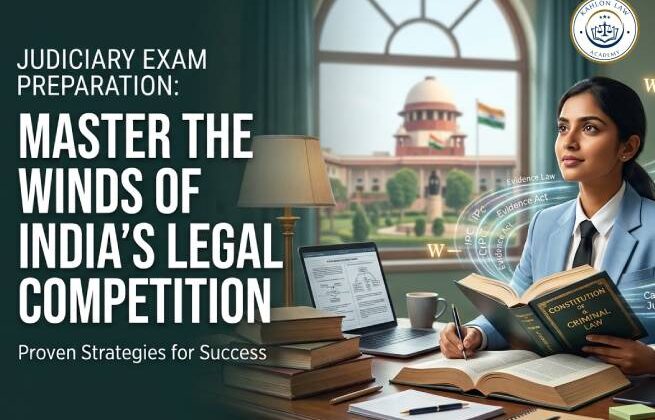
Judiciary Exam Preparation: Master the Winds of India’s Legal Competition
You’ve studied the law. You know your Bare Acts. You’ve spent hours understanding judgments and solving questions. But are you ready to compete with India’s sharpest legal minds?
That’s where your real journey begins.
Judicial services examinations bring together capable candidates competing for limited vacancies. Knowing the law is your starting point. Learning to apply it with precision is what moves you forward.
Think of yourself on a windsurfing board. The winds are strong. The waters are unpredictable. You cannot control them. But you can learn to navigate them.
Your judiciary preparation demands the same skill.
Start With What You Know. Find What You Don’t.
You already have a foundation in law. But how much of it can you recall and apply under pressure?
Think about it.
You may understand a provision while reading it.
- But can you identify its exceptions in a tricky question?
- Can you distinguish it from similar ones?
That’s where your preparation needs to begin.
You’re competing with many elite candidates. And they might have studied the same subjects following similar resources. The difference lies in how well you apply what you’ve learned.
Compare the official state-wise syllabus with your existing knowledge.
- Which topics can you explain confidently?
- Which provisions do you often confuse?
- Which subjects need more revision?
Be honest while preparing. You cannot fix a gap you haven’t seen yet.
Learn to Read the Winds Before You Move
You might feel productive after finishing another book. Or preparing a fresh set of notes. But does that mean you’re better prepared for the examination?
That’s not how it works.
Reading a topic is one thing. And being able to apply it is another. These can’t be the same ever.
Break your syllabus into specific areas. Connect each topic with the relevant Bare Acts, important judgments, and practice questions. Check the requirements of your target state as well. Judicial services examinations can differ. This includes syllabi, local laws, language requirements, and examination patterns.
Now decide what each topic needs.
| Your current position | What you should do |
| You understand the concept | Test your application |
| You confuse similar provisions | Compare their ingredients and exceptions |
| You struggle to recall details | Revise the relevant statutory provisions |
| You haven’t covered the topic | Build your understanding first |
Don’t study every topic in the same way. Read the conditions. Adjust your approach.
That’s how you stop moving blindly through the syllabus.
Use Case Law to Find Your Direction
You encounter an important judgment. You remember its name and the court’s conclusion.
But can you explain why the court reached that conclusion?
That matters.
A judgment may clarify a provision, establish a legal principle, or distinguish an earlier decision. Memorising its name won’t necessarily help you apply it to another question.
When studying a case, identify the following:
| What to study | What you need to understand |
| Legal issue | What question did the court address? |
| Relevant provision | Which law applied? |
| Court’s reasoning | Why did the court reach its conclusion? |
| Legal principle | What did the judgment establish or clarify? |
| Current relevance | Does it remain applicable under the law relevant to your examination? |
Connect each judgment with its syllabus topic. Check statutory amendments and the applicable legal framework. Especially when studying India’s revised or new criminal laws.
Think of case law as your compass. It helps you understand the direction of a legal principle. You still need to know how to navigate the question in front of you.
Kahlon Law Academy’s case law resources can help you follow relevant judgments and judicial developments.
Turn Every Mock Test Into a Lesson
You finish a mock test and check your score.
Good. But don’t stop there.
Your score tells you how you performed. Your mistakes tell you what to improve.
Look at every incorrect answer. Then identify why you got it wrong.
| Your mistake | Your next move |
| You didn’t understand the concept | Revisit the legal principle |
| You confused two provisions | Compare their ingredients and exceptions |
| You missed a legal development | Review the relevant judgment or amendment |
| You applied the law incorrectly | Practise fact-based questions |
| You ran out of time | Attempt more timed papers |
Keep a record of recurring mistakes. Review them before your next test.
If you keep making the same error, reading the same material again may not help. You need to understand what’s causing it.
Kahlon Law Academy offers mock tests for selected criminal law subjects. Use them when those subjects form part of your preparation.
Your Competition Is Tough. Learn to Navigate It.
You’ve come this far because you have the knowledge and the ambition to pursue judicial services. Now you need to turn that foundation into examination readiness.
You’re competing with candidates who take the law seriously. Some will know the same provisions. Others will have practised the same questions.
Your advantage comes from understanding your gaps, recognising legal distinctions, and learning from every mistake.