
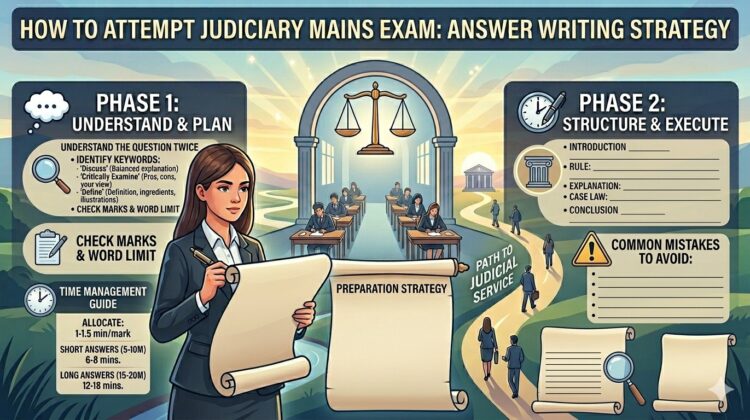
HOW TO ATTEMPT JUDICIARY MAINS EXAM: ANSWER WRITING STRATEGY
The “Judiciary Mains Examination” (for Civil Judge or Higher Judicial Services in various states) tests not just your legal knowledge but your ability to apply it clearly, logically, and concisely. Unlike Prelims, which focus on objective recall, Mains evaluates your analytical skills, structured thinking, and presentation—qualities essential for a future judge.
Answer writing is the “Game changer” in Judiciary Mains. A well-structured, precise answer can fetch high marks even with average content, while a rambling one may score poorly despite strong knowledge. Here’s a comprehensive strategy to master it.
- UNDERSTAND THE QUESTION THOROUGHLY (FIRST STEP TO SUCCESS)
Before picking up your pen, spend 30–60 seconds analyzing the question.
- Identify “keywords”: “Discuss”, “Explain”, “Critically examine”, “Define”, “Elucidate”, or “Comment upon”.
- “Discuss/Explain”: Balanced explanation with provisions and cases.
- “Critically examine/analyze”: Pros, cons, judicial evolution, and your reasoned view.
- “Define”: Focus on legal definition, ingredients, and illustrations.
- Break down sub-parts if any.
- Note the “marks” and “word limit” (if mentioned) to gauge depth.
“Tip”: – Underline key terms mentally. Answering what is *not* asked is a common mistake that wastes time and marks.
- FOLLOW A CLEAR STRUCTURE: THE BACKBONE OF HIGH-SCORING ANSWERS
Examiners appreciate “readable, logical, and Judicial style” answers. Use the classic “Introduction – Body – Conclusion” format. A popular variation for law-specific questions is the “IRECC” model:
– “I – Introduction”: 2–4 lines. Define the concept, mention the relevant Article/Section, or give brief context.
– “R – Rule”: Quote or paraphrase the exact Bare Act provision (e.g., Section 300 CrPC or Article 21).
– “E – Explanation”: Break down ingredients, principles, exceptions, and application.
– “C – Case Law”: Cite 1–2 landmark or recent Supreme Court/High Court judgments with brief ratio (e.g., *Maneka Gandhi v. Union of India* for expanding Article 21).
– “C – Conclusion”: 2–3 lines. Summarize, give a balanced judicial observation, or link to broader principles (e.g., “Thus, the provision balances individual rights with societal interests.”).
Alternative Simple Structure (works for most questions):-
– “Introduction” — Set the tone.
– “Body” — Use headings/sub-headings or bullet points for clarity.
– “Conclusion” — Crisp ending.
Presentation Tips: –
– Use “headings” and “sub-headings” (e.g., “Constitutional Provisions”, “Judicial Interpretation”).
– Employ “bullet points” or short paragraphs for multiple aspects.
– Underline key terms, sections, or case names sparingly for emphasis.
– Maintain neat “handwriting” with proper spacing and margins. Avoid overwriting.
- CONTENT ESSENTIALS: WHAT TO INCLUDE
– “Bare Acts”: Prioritize accurate statutory language. Don’t copy verbatim excessively; explain in your words.
– “Case Laws”: Essential for depth. Use landmark cases (e.g., *Kesavananda Bharati* for basic structure) and recent ones where relevant. Mention year and brief holding, not full facts.
– “Interlinkages”: Connect provisions across laws (e.g., CrPC with Constitution or Evidence Act).
– “Examples”: Hypothetical or real-life illustrations to show application.
– “Balanced View”: For critical questions, discuss both sides before concluding.
Keep language “formal, precise, and objective” — like a judgment. Avoid personal opinions, flowery language, or irrelevant details.
- TIME MANAGEMENT DURING THE EXAM
Mains papers often have many questions in limited time (e.g., 3 hours for 100–200 marks).
– “Allocate time” based on marks: Roughly 1–1.5 minutes per mark (practice to refine).
– Short answers (5–10 marks): 6–8 minutes.
– Long answers (15–20 marks): 12–18 minutes.
– Attempt “all questions”. Partial answers score better than blanks.
– Start with questions you know best to build confidence and save time.
– Leave 5–10 minutes for revision at the end.
“Practice Tip” :- Solve previous year papers and mock tests under strict timed conditions. Aim to write 2–3 full answers daily during preparation.
- COMMON MISTAKES TO AVOID
Many candidates lose marks due to these pitfalls:
– Lack of structure → Answers look scattered.
– Overly lengthy introductions or irrelevant content.
– Missing or incorrect case laws and sections.
– Poor time management (spending too much on one question).
– Bad presentation: Illegible handwriting, no spacing, or dense paragraphs.
– Ignoring word limits or question keywords (e.g., not being “critical” when asked).
– Repetition or writing what you know instead of what is asked.
- PREPARATION STRATEGY FOR ANSWER WRITING
– “Daily Practice”: Pick one question each from Civil Law, Criminal Law, Constitutional Law, and local laws. Write full answers and self-evaluate.
– “Build a Synopsis”: Maintain notes with standard introductions, key provisions, landmark cases, and conclusions for quick recall.
– “Get Feedback”: Join answer writing programs, get evaluated by mentors, or compare with model answers/topper copies.
– “Revise Bare Acts & Judgments”: Focus on understanding rather than rote learning. Revise key cases regularly.
– “Improve Speed”: Start slow for quality, then add time pressure. Practice neat handwriting.
– “Analyze PYQs”: Understand recurring themes and how toppers structure similar questions.
- SAMPLE ANSWER OUTLINE (QUICK EXAMPLE)
“Question”: Discuss the doctrine of Res Judicata under the Code of Civil Procedure.
– “Introduction”: Res Judicata, meaning “a thing adjudicated,” prevents re-litigation of the same matter. It is enshrined in Section 11 CPC.
– “Body”:
– Explain ingredients (same parties, same matter in issue, final decision on merits, competent court).
– Discuss exceptions and constructive res judicata (Explanation IV).
– Key Case: *Satyadhyan Ghosal v. Deorajin Debi* (principles) or recent SC rulings on its application.
– “Conclusion”: The doctrine ensures finality of litigation, judicial economy, and prevents harassment, upholding the rule of law.
Mastering answer writing takes consistent effort, but it is highly rewarding. It not only boosts your Mains score but also prepares you for the actual role of a judge — clear, reasoned, and just decision-making.
“Final Advice”: Treat every answer as a mini-judgment. Be accurate, structured, and to the point. With regular practice, you will develop the confidence and skill to excel in Judiciary Mains.
Start today — pick a question, set a timer, and write! Consistency will turn good answers into excellent ones.
*Wishing you success in your judicial journey!*
If you’re preparing for a specific state (e.g., Punjab, Rajasthan, UP, Bihar), tailor the strategy to that state’s syllabus and past trends.




Comments are closed.